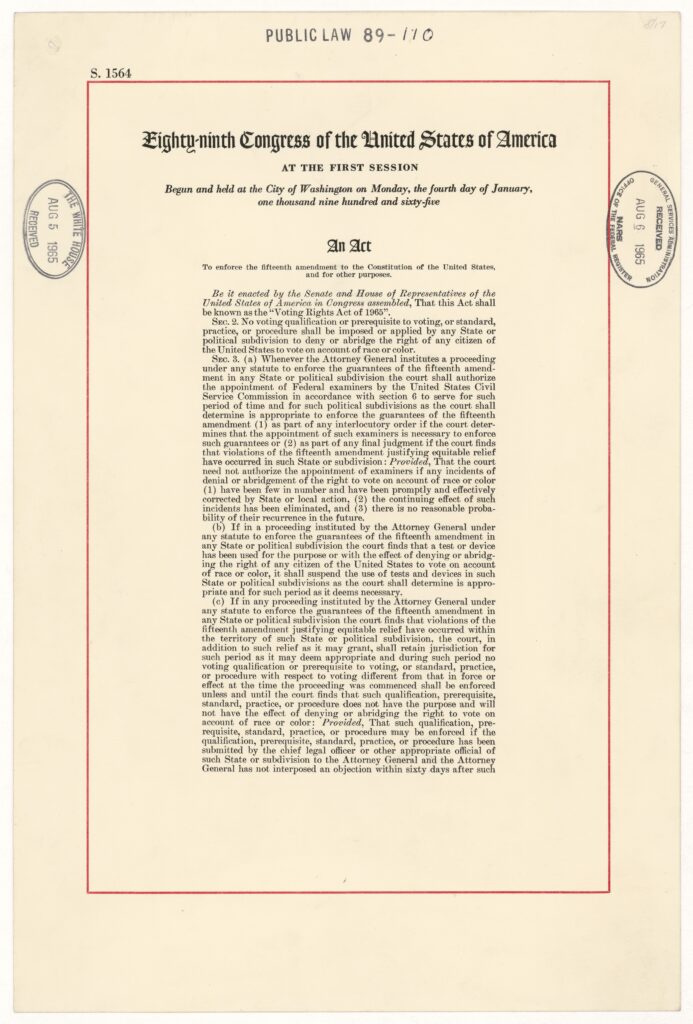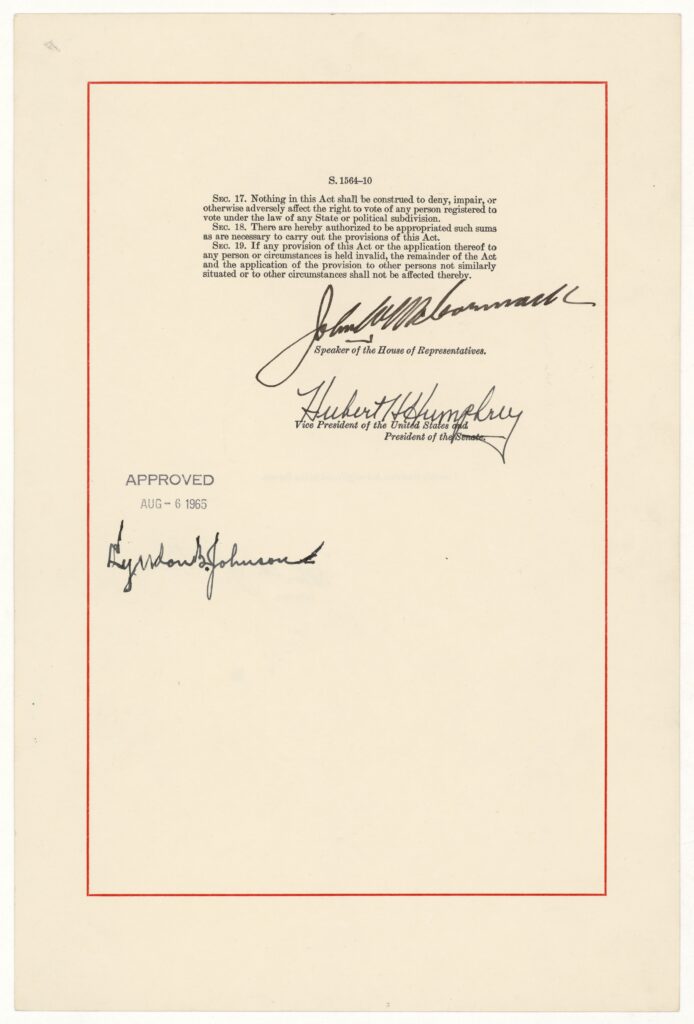
On August 6, 1965, President Lyndon Baines Johnson signed the Voting Rights Act into law, a momentous achievement in the struggle for equal rights.
When President Lincoln signed the Thirteenth Amendment, freeing the nation’s slaves on January 31, 1865, it was not the end of oppression of African Americans, but rather the beginning of a journey toward full citizenship and participation in the democratic process. The 15th Amendment, passed in 1870, stated that “The right of citizens of the United States to vote shall not be denied or abridged by the United States or by any State on account of race, color, or previous condition of servitude.” However, many Southern states began to deny African Americans their constitutional rights by creating poll taxes and convoluting the methods of voter registration to discriminate against African Americans.
African Americans were not only discriminated against with regards to voting rights, but in almost all other aspects of their lives due to the Plessy v. Ferguson (1896) Supreme Court judgment, which allowed for the separate but equal treatment of the races. In 1954, the case was overturned by the Supreme Court judgement in Brown v. The Board of Education, propelling the Civil Rights movement forward, and encouraging leaders such as Dr. Martin Luther King, Jr., to continue the fight for equal rights, including voting rights.
Through nationwide peaceful demonstrations, the Civil Rights movement captured the attention of the media, the public, and politicians alike. It became clear that the vast majority Americans were unwilling to tolerate the discriminatory practices of certain states.
Many years of activism culminated in the signing of the Voting Rights Act. The Act prohibited any jurisdiction from implementing a “voting qualification or prerequisite to voting, or standard, practice, or procedure … in a manner which results in a denial or abridgement of the right … to vote on account of race,” color or creed. The results were instantaneous: 250,000 new voters were registered by the end of 1965 and more than half of all African American citizens were registered by 1967.
In 2013, the Supreme Court overturned a key provision in the Act, which explicitly forbade states from changing their election laws without federal approval. Immediately, representatives such as Congressman John Lewis began drafting legislation to reinstate it. The proposed reinstatement of the original provision from the 1965 law has received bipartisan backing.
The images shown here are scans of the first and signature pages of this act. Download a high-resolution version of the entire act from the National Archives’ online catalog.